
The Paris to Amsterdam rail trip is one of those routes where the headline number does not tell the whole story. The practical answer to how far is Paris from Amsterdam by train is that the direct route is roughly 430-530 km, depending on how the rail distance is measured, and the fastest trains cover it in a little over 3 hours. In this guide, I break down the real journey time, what changes the ride length, how the direct service compares with flying, and what I would check before booking.
Key facts for a Paris to Amsterdam rail trip
- The fastest direct train usually takes about 3 hours 20 minutes.
- The rail distance is commonly shown in the 430-530 km range, depending on the measurement used.
- In 2026, there are multiple departures a day, but not every hour, so timing still matters.
- The trip is city centre to city centre, which is a major advantage over flying.
- Early booking usually gives the best fares and the least stress.
The distance is shorter than the map suggests
When people ask about the Paris-Amsterdam train, they usually want two things at once: the actual distance and the time they need to set aside. I think the time is the more useful number, but the distance still helps set expectations. On rail, this is not a straight line between two capitals; it is a high-speed corridor that crosses borders, follows fixed tracks, and connects central stations rather than airports.
That is why distance figures vary a little. Some route planners quote the rail journey at just over 500 km, while others show a lower figure closer to 430 km. The difference is usually about what is being measured: the physical rail line, the timetable route, or a simplified station-to-station estimate. For travellers, the point is simple: this is a relatively short international train journey by European standards, and it feels much quicker than the raw kilometres suggest.
| What you are measuring | Approximate figure | Why it matters |
|---|---|---|
| Rail distance | About 430-530 km | Different booking systems and route calculations use different reference points |
| Fastest direct travel time | About 3 hours 20 minutes | This is the number that matters most for planning a day trip or short break |
| Real-world door-to-door time | Often 4-5 hours | Station arrival, transfers, and local travel still need to be counted |
Once you look at it that way, the rail question stops being about pure mileage and becomes a planning question. That leads naturally to the service most people actually want to know about.
The direct Eurostar is the number that matters most
For a straightforward trip, the direct high-speed service is the benchmark. Eurostar currently sells the Paris-Amsterdam journey as a direct city-centre connection in about 3 hours 20 minutes, and SNCF Connect shows the route at 527 km with the quickest departures at 3 hours 28 minutes. Those are close enough that I would treat them as the same planning range: just over 3 hours if everything is running normally.
This is why the train works so well on this route. You avoid airport transfers, you stay in the centre of both cities, and you do not lose half a day to waiting around at terminals. In practical terms, the trip is long enough to settle in with a drink or a laptop, but short enough that it never feels like a haul. I would call it one of the cleanest international rail journeys in western Europe.
There are usually several departures a day rather than a dense suburban-style schedule, so the departure time still matters. If you want the easiest version of the journey, the best approach is to choose a direct train and build your day around it, not the other way around. That also helps explain why the ride length can look different from one search result to another.
The next thing most travellers want to know is what actually changes that travel time in practice.
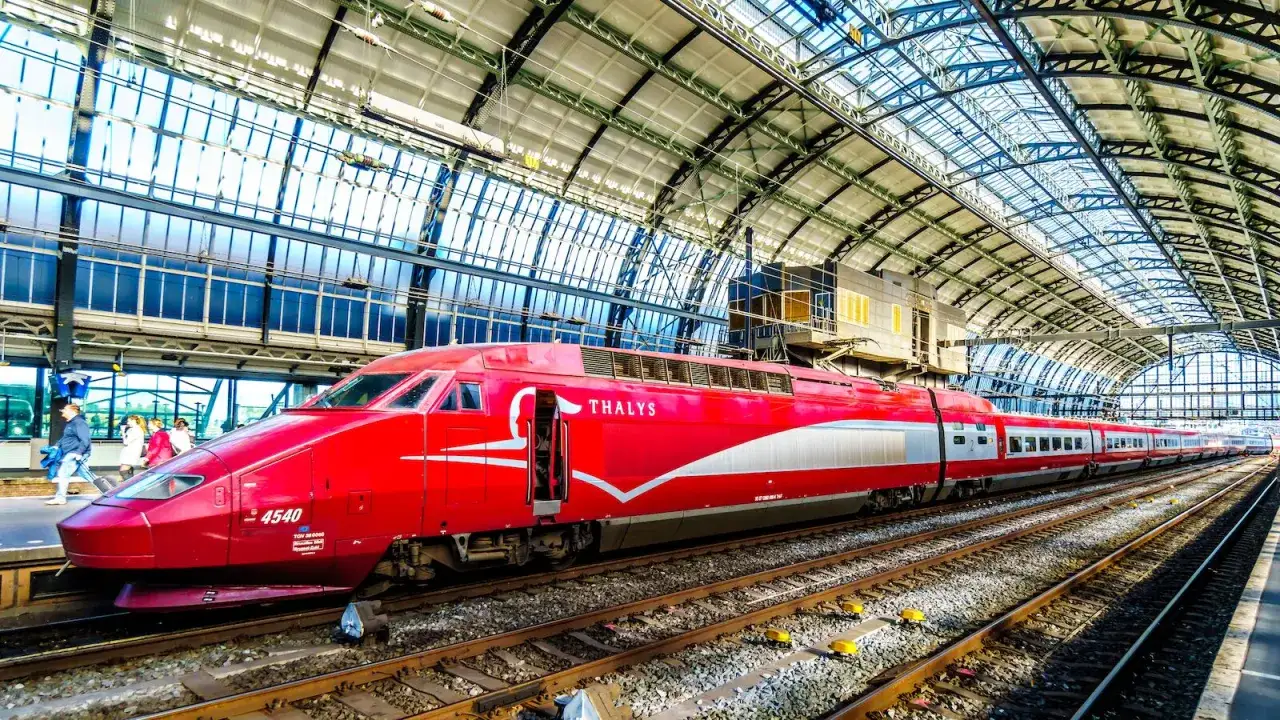
What the journey feels like once you are on board
I would describe this route as calm rather than scenic. You are not buying it for mountain views or dramatic coastal stretches. You are buying efficiency, comfort, and the sense that you can leave one city after breakfast and be in the other before lunch is fully over.
On a good direct service, the train feels very close to a moving lounge: seats are wider than economy air travel, luggage is easier to manage, and there is usually enough space to work, read, or simply switch off. For many travellers, that matters more than a small difference in ticket price. If I am travelling with a laptop or a cabin bag plus a suitcase, I prefer the train because the whole process feels less fragmented.
- City-centre departure and arrival save time before and after the ride.
- No airport security queue means the trip feels less exhausting.
- Wi-Fi and power sockets make the journey usable as working time.
- Luggage is simpler than on most flights, especially for short breaks.
The ride itself is only half the story, though. The other half is why one search result says 3 hours 20 minutes and another says something slightly longer.
Why the travel time varies from one search to another
The biggest reason for variation is that not every result is measuring the same thing. Some quotes are pure in-train time, while others include station dwell time, timetable padding, or the time needed for a connection if the fastest direct service is not available. On international rail, those small differences add up quickly.
Several practical factors can stretch the journey:
- Direct versus connecting service is the biggest difference of all.
- Time of day can change the scheduled running time by a few minutes.
- Engineering work or timetable changes sometimes alter the route or the connection pattern.
- Station procedures and boarding time affect the overall trip, even if the train itself stays fast.
For that reason, I would never plan around the fastest number alone. I would plan around a sensible range and leave a bit of breathing room at each end. That is especially useful if you are deciding between train and plane, because the most important comparison is not just speed but whole-journey convenience.
When the train beats flying and when it does not
| Option | Typical total time | Best for | Trade-off |
|---|---|---|---|
| Direct train | About 3h20 on board, about 4-5h door to door | Travellers who want the easiest city-to-city transfer | Usually not the absolute cheapest at the last minute |
| Flight | Often 4-6h door to door | People who find a very good fare and are close to the airport | Airport time can erase the speed advantage |
| Train with a change | Usually longer than the direct train | When the direct service is sold out or badly timed | More walking, more risk, and less comfort |
If I am honest, this is one of those routes where the train wins more often than not. Flying can look faster on paper, but once you add airport transfers, early arrival, and the drag of leaving and re-entering the airport system, the advantage shrinks fast. The train is not always the cheapest answer, but it is often the cleanest one.
That said, cost still matters, and there are a few booking habits that can save real money.
How to book smartly without paying too much
For this route, booking early usually matters more than hunting endlessly for the perfect fare. The cheapest seats tend to go first, especially on Friday afternoons, Sunday evenings, and holiday periods. If your dates are flexible, moving even by one day can make a real difference.
I would also be careful about comparing headline fares only. A cheap train ticket that leaves at an awkward time, or a flight that needs an extra airport transfer and bag fee, may not be the best value in the end. On this route, value is a combination of price, timing, comfort, and how much friction you are willing to accept.
- Book as early as you reasonably can.
- Check midweek departures before defaulting to weekends.
- Compare the fare with your total door-to-door cost, not just the ticket price.
- Be wary of last-minute options if you need a specific departure time.
Once the ticket is sorted, the final win is simple: avoid small mistakes that create big stress on travel day.
The few checks that make the trip smoother
The route is easy, but ease only stays easy if you handle the basics well. I would start with the station names, because Paris and Amsterdam are both large rail hubs and it helps to know exactly where you are leaving from and arriving to: Paris Gare du Nord and Amsterdam Centraal. I would then check the departure time, platform updates, and whether my ticket is digital or needs to be ready in another format.
For European international rail, I also prefer to arrive with a little margin rather than cutting it fine. Even when the boarding process is straightforward, extra minutes disappear quickly once you add luggage, a coffee stop, or a platform change. The habit that saves the most time is surprisingly boring: know your departure point, keep your ticket accessible, and do not assume the first fare you see is the best one.That is the real answer to the trip: Paris and Amsterdam are far enough apart to justify a proper high-speed journey, but close enough that the train feels efficient, comfortable, and surprisingly simple. If you want the shortest version of the story, I would remember this much: the direct ride is around 3 hours 20 minutes, the rail distance is roughly half a thousand kilometres depending on how it is measured, and the train usually gives you the best balance of convenience and value for a city break between the two capitals.